Before State Lines, There Was the Mississippi River: Tracing Land, Continuity, and Ownership in Louisiana
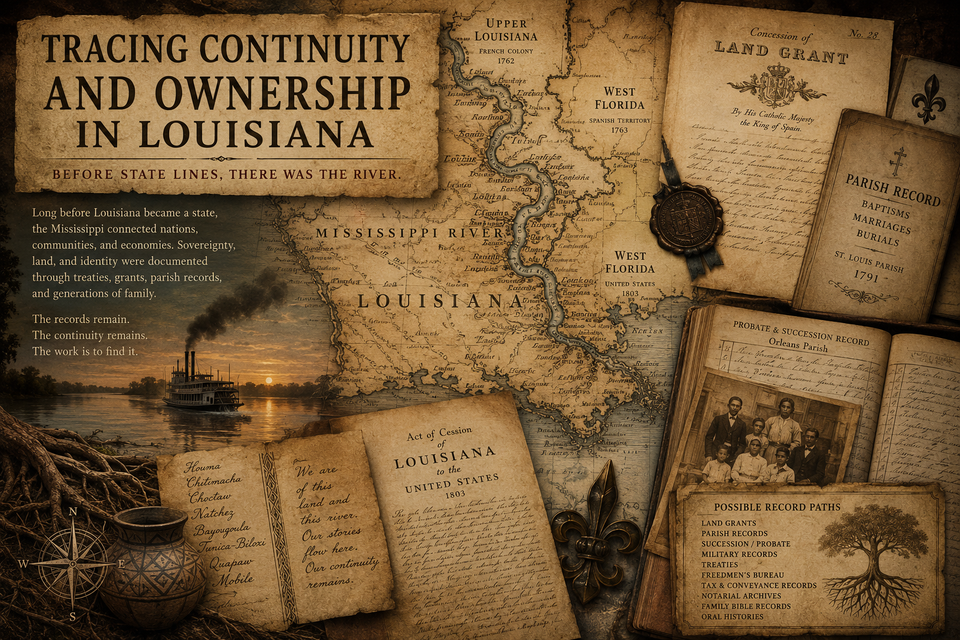
Before State Lines, There Was the River
Long before Louisiana became a state,
before Oklahoma existed,
before many modern borders hardened into permanence,
the Mississippi River already connected worlds.
Not symbolically.
Practically.
The river carried trade,
migration,
governance,
language,
agriculture,
war,
ceremony,
commerce,
and continuity across generations long before the United States expanded across the continent.
Indigenous nations moved through these waterways.
African people were forced into them.
Colonial governments organized themselves around them.
Entire communities built systems of life along them.
And because so many worlds converged there, the Mississippi corridor became one of the most layered continuity regions in North America.
This matters for descendants today because many people connected to Louisiana, the lower Mississippi Valley, and surrounding territories inherited histories that existed before modern American identity categories fully stabilized.
French.
Spanish.
Indigenous.
African.
Creole.
Free people of color.
Territorial militia systems.
Catholic parish systems.
River commerce communities.
Mixed-status settlements.
Land grant families.
Treaty territories.
These histories often overlapped one another long before the United States attempted to reorganize them into rigid racial, political, and administrative classifications.
That means continuity in Louisiana is rarely simple.
And it also means many descendants inherited fragmented stories without inheriting the frameworks needed to understand how those stories once connected together.
A family may remember Native ancestry but not know which nation.
Another may remember land ownership without understanding the colonial grant system attached to it.
Some inherit French surnames attached to African ancestry.
Others inherit Indigenous continuity hidden beneath racial reclassification over generations.
Some inherit property records that predate American governance entirely.
And many inherit stories shaped by categories that changed repeatedly depending on which government controlled the territory at the time.
French classifications.
Spanish classifications.
American classifications.
Census classifications.
Racial reclassification.
Property status.
Citizenship changes.
Territorial transfers.
Over time, entire communities could remain physically present while becoming historically separated from the continuity that once explained them.
This is part of why tracing continuity along the Mississippi often requires descendants to think beyond modern assumptions about race, nationality, and identity.
Because the river existed before those categories hardened into what people recognize today.
And the records reflect that complexity.
For descendants beginning this work, continuity may appear through:
- French or Spanish land grants,
- parish baptism and marriage records,
- succession and probate files,
- notarial archives,
- military service records,
- treaty references,
- territorial censuses,
- Freedmen’s Bureau documents,
- tax rolls,
- conveyance records,
- plantation inventories,
- river transport records,
- court petitions,
- or repeated family relationships tied to the same region across generations.
Sometimes continuity survives through land.
Sometimes through surnames.
Sometimes through parish systems.
Sometimes through oral memory carried quietly inside families long after the original framework surrounding that memory became fragmented.
And sometimes the interruption itself becomes part of the documentary trail.
This is one reason Louisiana remains such an important region for continuity research.
Not because the histories there are simple.
But because they are layered deeply enough to reveal how sovereignty, land, race, inheritance, and governance continuously reshaped one another across generations.
Many descendants today are still living inside the consequences of those transitions without fully realizing how much of that continuity was documented along the way.
And often, reconstruction begins the same way the river itself moves:
quietly,
gradually,
following pathways that existed long before modern boundaries tried to contain them.