How to Begin Tracing Continuity Through the Five Nations
For many descendants today, the search for continuity begins with fragments.
A family story about Cherokee ancestry.
A relative who once lived in Oklahoma.
An old reference to “Indian Territory.”
A rumor about land, allotments, or being “on the rolls.”
A surname repeated across generations without explanation.
Sometimes these stories remain vague for decades because the historical systems surrounding them were never fully explained to the descendants who inherited them.
This is part of why Sovereign Continuity Project is beginning its research focus with the nations historically referred to as the Five Civilized Tribes:
the Cherokee,
Choctaw,
Chickasaw,
Creek,
and Seminole Nations.
Not because these nations represent all Indigenous continuity in North America.
And not because other sovereign histories matter less.
But because the descendants connected to these nations represent one of the largest and most documentable groups of people whose sovereign continuity became formally recorded, reorganized, fragmented, and redistributed through federal systems over time.
The scale matters.
The records matter.
And the interruption itself produced an enormous documentary trail that many descendants still do not realize exists.
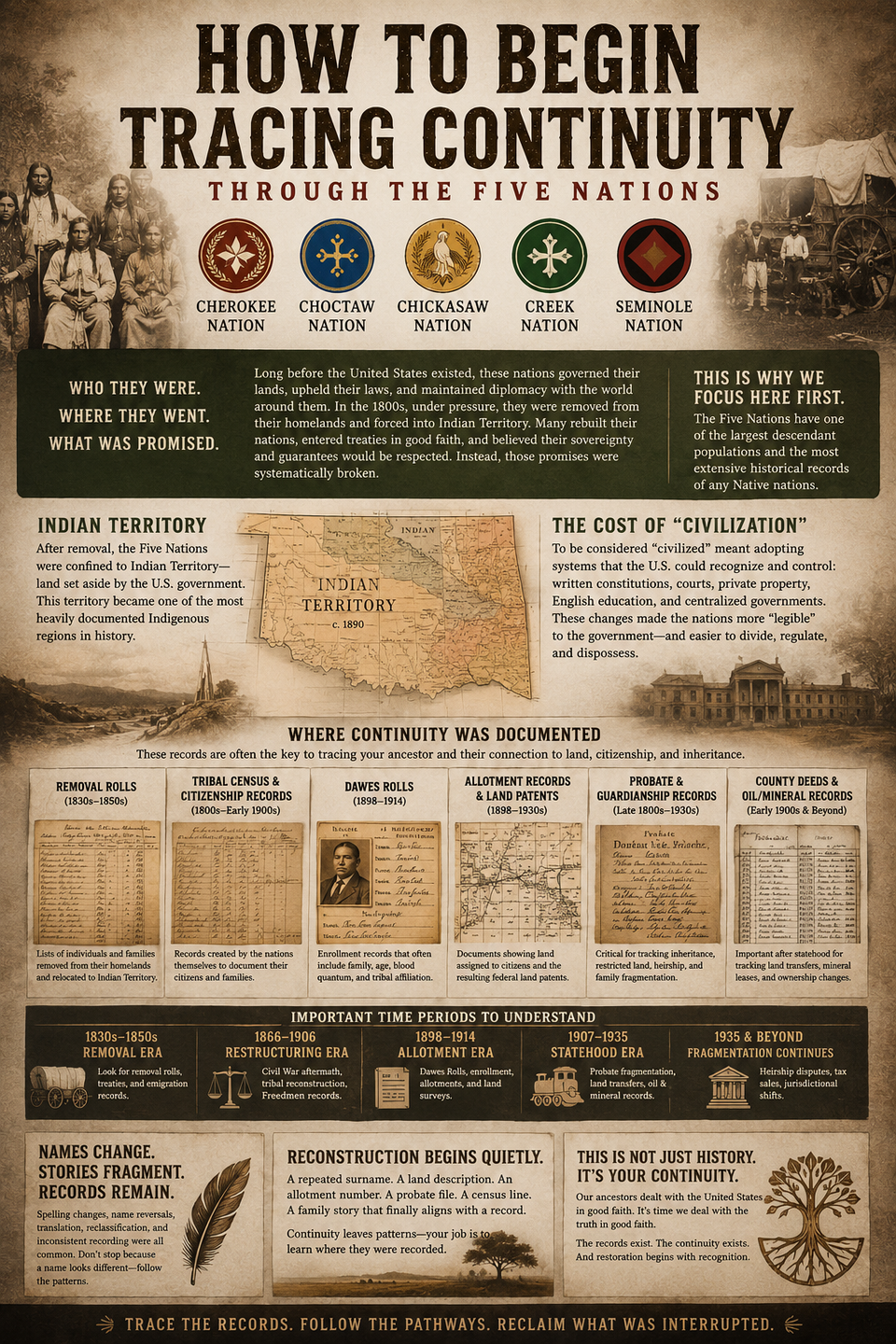
Long before Oklahoma became a state, much of the region was designated as Indian Territory following forced removal policies carried out during the nineteenth century.
Entire nations were displaced from their ancestral homelands in the Southeast and relocated westward through treaty systems, military pressure, negotiated agreements, and removal campaigns that reshaped generations.
Once relocated, these nations rebuilt governments, courts, schools, constitutions, citizenship systems, and territorial structures inside what became Indian Territory.
For a period, many believed those relationships and guarantees would remain protected through treaty law and federal recognition.
Instead, Indian Territory eventually became one of the most administratively documented sites of interrupted continuity in American history.
Citizenship rolls were created.
Land was surveyed.
Allotments were assigned.
Inheritance systems were reorganized.
Blood classifications were imposed.
Guardianships were established.
Probate systems fragmented land ownership across generations.
And statehood accelerated the transfer of authority away from tribal territorial governance and into surrounding federal and state systems.
The result is that many descendants today inherited the consequences of interruption without inheriting a clear understanding of how thoroughly their continuity was once documented.
That documentation matters.
Because for many descendants, reconstruction begins there.
Not with mythology.
Not with vague identity claims detached from history.
But with continuity that can still be traced through records.
This is why the Five Nations provide such an important starting point for descendants beginning this work.
The documentary systems surrounding these nations are often extensive enough to allow continuity to be followed across generations when people know where to look.
And often, the first step is much simpler than people expect.
It begins with identifying the most recent confirmed ancestor connected to:
- Indian Territory,
- one of the Five Nations,
- allotment land,
- treaty citizenship,
- Freedmen enrollment,
- or tribal records.
From there, continuity can often be traced backward through historical systems that documented relationships between people, land, citizenship, and inheritance.
Some of the most important records include:
Removal Rolls (1830s–1850s)
Records connected to forced removal from the Southeast into Indian Territory.
Tribal Census and Citizenship Records
Used by nations to document recognized citizens and families over time.
Dawes Rolls (1898–1914)
Enrollment records created during allotment that often include family groupings, census information, blood classifications, and citizenship references.
Allotment Records and Land Patents
Documents tied to land distribution inside Indian Territory before Oklahoma statehood.
Probate and Guardianship Records
Often critical for tracing inheritance fragmentation, restricted land, mineral rights, and heirship continuity across generations.
County Deeds and Oil & Mineral Records
Especially important after Oklahoma statehood, when land ownership and extraction systems accelerated fragmentation and transfer.
Not every family story survives intact.
Names change.
Records become inconsistent.
Communities become reclassified over time.
And many descendants inherit fragments rather than complete historical frameworks.
But interruption does not erase the fact that continuity once existed.
And records have a way of preserving relationships long after public memory begins forgetting them.
Most people approach ancestry searching for identity.
This project approaches continuity searching for recognition.
The goal is not simply to ask:
“Who were my ancestors?”
The deeper question is:
What systems already recognized them before continuity became interrupted?
Because restoration begins there.