Sovereignty Leaves Records
Many communities across the world have endured injustice, dispossession, forced assimilation, discrimination, violence, and historical crimes that reshaped generations.
That reality is not in question.
Sovereign Continuity Project approaches a more specific kind of interruption.
Not simply the interruption of comfort.
Or opportunity.
Or social standing.
The interruption this project examines is continuity itself.
More specifically:
the interruption of historically recognized continuity tied to land, governance, treaty relationships, inheritance, citizenship, territorial belonging, and sovereign identity that was once formally acknowledged — then altered, displaced, obscured, dissolved, or otherwise interrupted over time.
That distinction matters.
Because many people today inherit the consequences of those interruptions without inheriting clear access to the records, frameworks, or historical language needed to fully understand what was interrupted in the first place.
And in many cases, the interruption did not begin with violence alone.
It continued through paperwork.
Through reclassification.
Through land transfers.
Through fragmented inheritance.
Through altered jurisdiction.
Through broken treaty obligations.
Through records becoming inaccessible, scattered, or disconnected from the descendants they once described.
Over time, entire communities could remain physically present while becoming historically separated from their own documented continuity.
That is the work this project is concerned with.
Not identity as performance.
Not self-invention detached from history.
And not generalized ancestry curiosity disconnected from documented relationships.
This work begins with continuity that can be traced.
That means Sovereign Continuity Project is specifically centered on descendants who can identify:
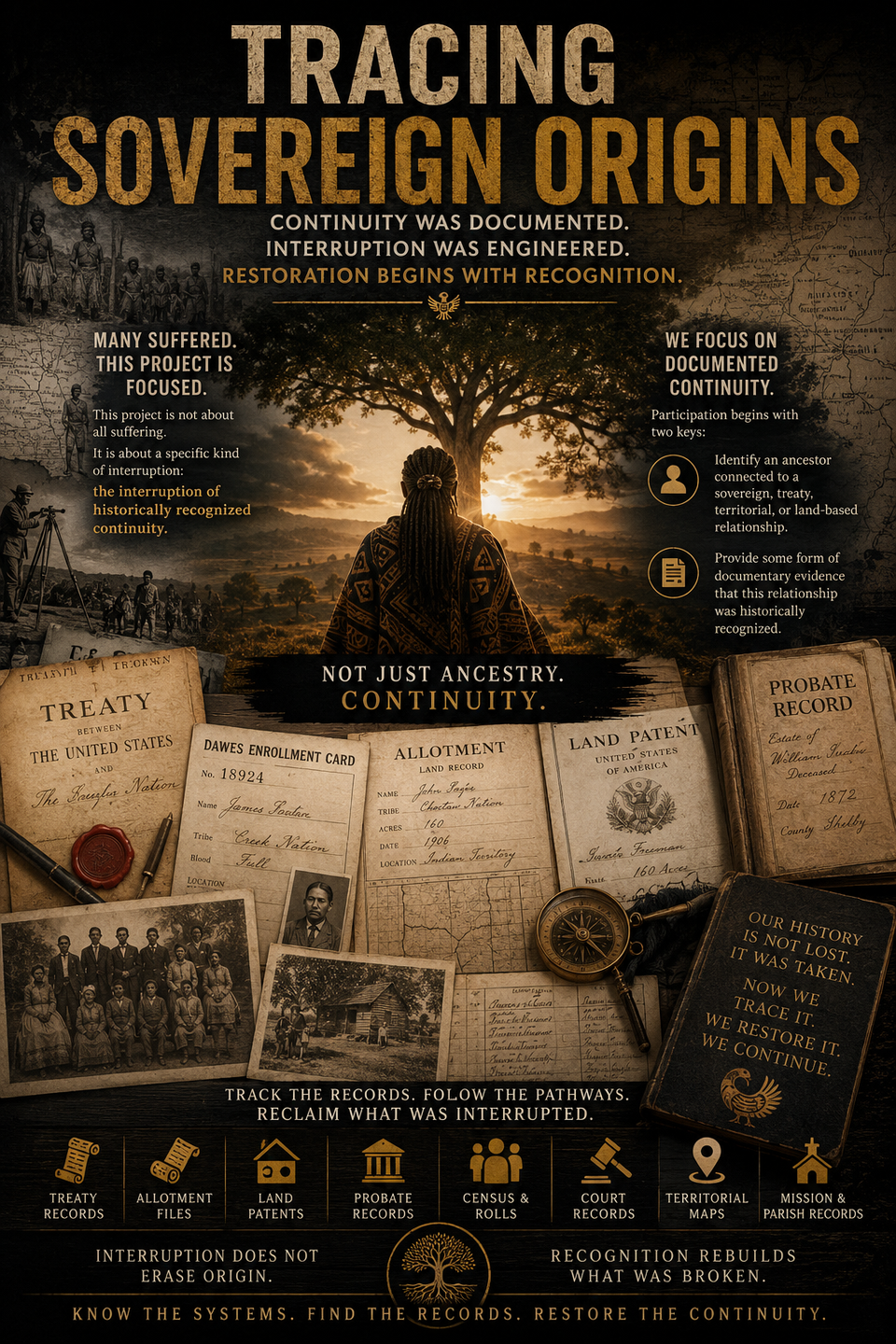
- an ancestor connected to a historically recognized sovereign, treaty, territorial, allotment, tribal, or land-based relationship,
- and some form of documentary continuity connected to that relationship.
Sometimes that evidence appears clearly.
Sometimes only fragments remain.
A treaty roll.
An allotment file.
A land patent.
A probate record.
A Dawes enrollment card.
A territorial census.
A parish register.
A court filing.
A family name appearing repeatedly in relation to the same land across generations.
Not all continuity survives intact.
But interruption does not erase the fact that continuity once existed.
And that is where reconstruction begins.
Most people are taught to approach ancestry as personal curiosity:
names,
photos,
DNA estimates,
old stories.
But continuity was also documented structurally.
Through governments.
Through treaties.
Through maps.
Through land records.
Through citizenship systems.
Through inheritance systems.
Through territorial relationships that carried legal and historical meaning far beyond individual identity alone.
Many descendants today are connected to those systems without fully realizing it.
Which means the first step is often not proving who you are.
It is learning what system your ancestors were already recognized within before that continuity became fragmented.
Because restoration cannot begin from abstraction.
It begins from recognition.
From learning:
- what relationships existed,
- how they were documented,
- what changed,
- what was interrupted,
- who benefited from that interruption,
- and what continuity may still remain beneath the surface of the present.
This project exists to help descendants begin tracing those pathways carefully, responsibly, and truthfully.
Not to invent continuity.
To recognize it.