Taking What’s Mine Doesn’t Make It Yours. It Makes It Stolen.
There are forms of interruption that affect land.
Forms that affect governance.
Forms that affect inheritance.
And then there are forms of interruption that affect the way people come to understand themselves.
Over time, entire communities can become more familiar with the way they were described by outsiders than with the way they once defined themselves from within their own continuity.
This is one of the quieter consequences of interruption.
And one of the most difficult forms of retrieval.
“Somebody almost walked off with all of my stuff.
Not my poems.
Not a dance I gave up in the street.
But my stuff.
Somebody almost walked off with all of my stuff
like a kleptomaniac working hard
and forgetting while stealing:
this is mine.
this ain’t your stuff.
What can anybody do with something
of no value on an open market?
Did you get a dime for my things?”
One of the lesser-discussed consequences of interrupted continuity is the gradual transfer of narrative authority.
Not only over land.
Or governance.
Or inheritance.
But over meaning itself.
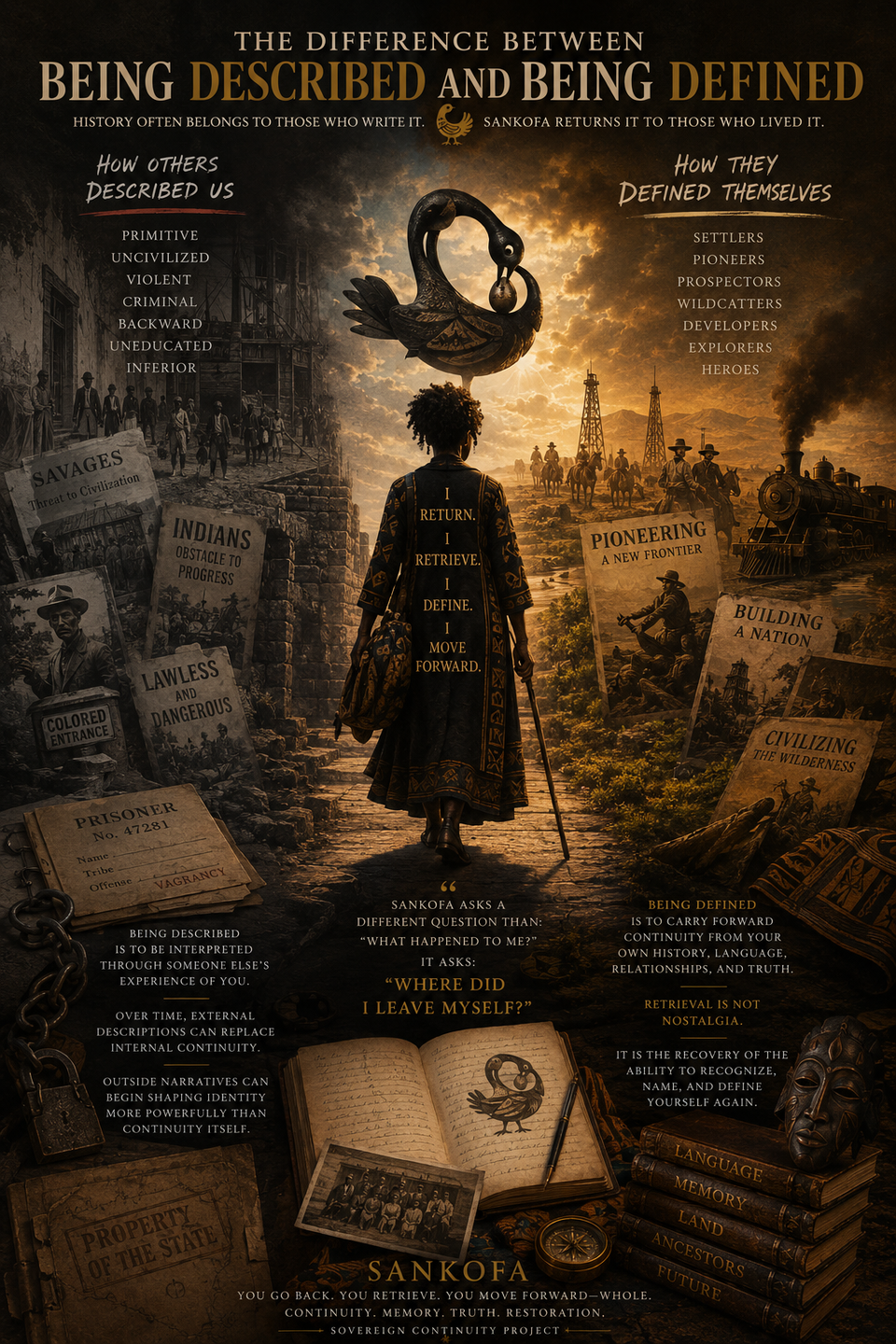
Throughout history, many communities experiencing displacement, interruption, or dispossession were described through the language of deficiency:
primitive.
violent.
criminal.
uncivilized.
backward.
Meanwhile, many participating in expansion into other people’s territories were defined through the language of progress and heroism:
settlers.
prospectors.
wildcatters.
pioneers.
developers.
History often normalizes the perspective of successful expansion.
And over generations, that normalization can begin feeling objective.
But being described is not the same thing as being defined.
“I want my arm with the hot iron scar.
And my leg with the flea bite.
I want my calloused feet
and my quick language back in my mouth.
Fried plantains.
Pineapple pear juice.
Sun-Ra and Joseph and Jules.
I want my own things —
how I lived them.
And give me my memories —
how I was
when I was there.
You can’t have them
or do nothing with them.”
Continuity is not only territory.
Or records.
Or institutions.
It is also the ability of a people to remain connected to their own systems of memory, relationship, meaning, and self-recognition across generations.
Interruption becomes especially powerful when descendants inherit outside descriptions before inheriting the continuity needed to evaluate those descriptions clearly.
Eventually, people may know more about how their ancestors were categorized than how their ancestors once understood themselves.
“Somebody almost run off with all of my stuff
and I was standing there
looking at myself
the whole time.
And it wasn’t a spirit that took my stuff.
It was a man
whose ego walked around like Rodan’s shadow.
It was a man faster than my innocence.
It was a lover
I made too much room for.
I didn’t know I’d give it up so quick.
And the one running with it
don’t know he got it.
And I’m shouting:
this is mine.
And he don’t know he got it.”
One of the deepest effects of interruption is that people can gradually begin organizing themselves around inherited external narratives rather than inherited continuity.
Communities described primarily through trauma, deficiency, or dependency can slowly lose proximity to their own internal definitions.
And when that happens long enough, outside narratives begin shaping identity more powerfully than continuity itself.
This is part of why retrieval matters.
Not to invent identity.
Not to romanticize the past.
But to recover enough continuity to recognize oneself outside inherited external framing.
“My stuff is the anonymous ripped-off treasure of the year.
Did you know somebody almost got away with me?
Me in a plastic bag under their arm.
Me dangling on a string
of personal carelessness.
Stealing my shit from me
don’t make it yours.
It makes it stolen.”
Interruption does not automatically become legitimacy simply because it survives long enough to normalize itself.
And survival of a narrative is not proof of truth.
Because continuity does not disappear simply because it was ignored, fragmented, displaced, or renamed.
Many histories remain unresolved beneath the narratives that replaced them.
And often, restoration begins the moment people recognize the difference.
“Why don’t you find your own things
and leave this package of me
for my destiny?
If it’s really my stuff,
you gotta give it to me.
And if you really want it —
I’m the only one who can handle it.”
Restoration is not the attempt to live in the past.
It is the refusal to let interruption become the final definition of who a people are.
You go back.
You retrieve what remains.
You recover the ability to distinguish between inherited description and inherited continuity.
And from there, you move forward —
not untouched,
not unchanged,
but whole enough to define yourself again.