Restoration Begins With Retrieval
In the modern world, restoration is often misunderstood.
People hear the word and imagine returning everything to the way it once was.
Undoing loss.
Undoing history.
Recreating the past exactly as it existed before interruption.
But history does not move backward.
And restoration is not the denial of interruption.
Restoration begins much more subtly than that.
It begins when people recognize that something essential was separated — and that the consequences of that separation continued long after the original interruption took place.
Sometimes those interruptions are visible.
Broken treaties.
Displacement from land.
Fragmented inheritance.
Forced assimilation.
Altered governance.
Scattered records.
Communities separated from the ability to define their own continuity.
But some interruptions become harder to recognize over time.
Families inherit stories without documentation.
Documentation survives without context.
Descendants carry consequences without inheriting the historical frameworks needed to fully understand them.
Many people feel this long before they have language for it.
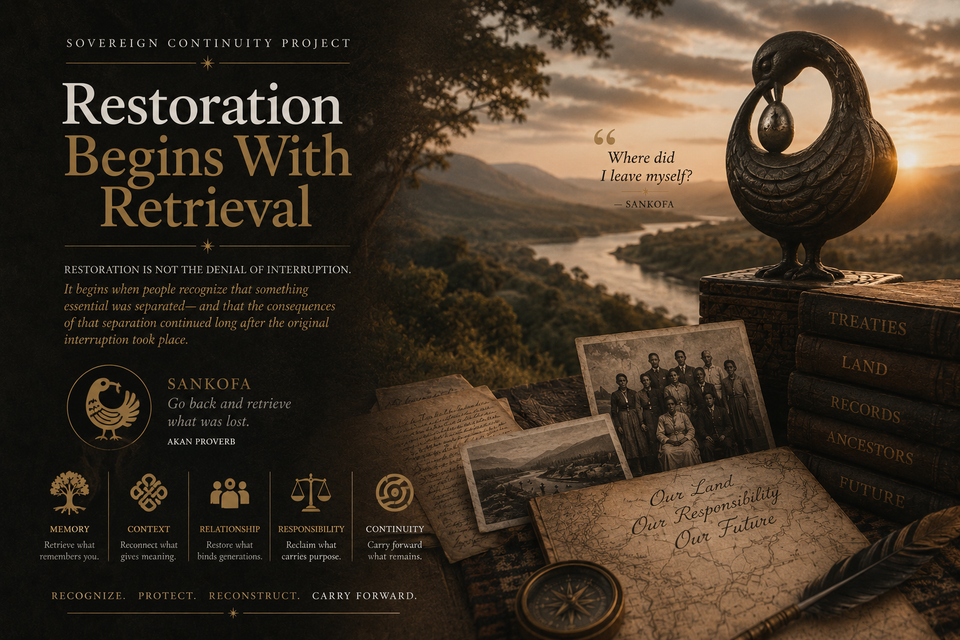
In the Akan language family of present-day Ghana, there is a concept called Sankofa, often translated as:
“Go back and retrieve what was lost.”
Sankofa is often symbolized by a bird moving forward while looking backward, carrying an egg in its beak — a reminder that continuity and future generations depend on what people are willing to retrieve rather than abandon.
But restoration is not nostalgia.
And Sankofa is not about living in the past.
Restoration begins with retrieval.
The retrieval of memory.
Context.
Relationship.
Responsibility.
Continuity itself.
Because interruption does not always erase what existed before it.
Sometimes it fragments it.
Separates people from the systems, relationships, and historical memory that once helped them understand themselves clearly.
And over time, people can adapt to interruption so completely that disconnection begins feeling normal.
Modern society encourages constant movement toward what comes next:
production,
consumption,
achievement,
reinvention,
survival.
Very little attention is given to what is being carried forward — or what had to be left behind in order to survive.
But adaptation is not always continuity.
And survival is not always wholeness.
One of the most powerful ideas associated with Sankofa asks a different question than:
“What happened to me?”
It asks:
“Where did I leave myself?”
That question matters because restoration is not only political, territorial, economic, or legal.
It can also involve recovering the ability to recognize oneself within histories that became interrupted.
To reconnect memory to land.
Responsibility to inheritance.
Descendants to historical context.
Communities to the continuity that once helped define them.
And yet interruption is not the same as absence.
This distinction matters.
Because continuity does not require perfection.
It only requires that enough remains for people to recognize themselves across time.
Enough memory.
Enough relationship.
Enough continuity still present beneath the interruption to retrieve what was never fully destroyed.
Restoration begins there.
Not with fantasy.
But with the willingness to recognize, protect, reconstruct, and carry forward what still remains.