What Is Continuity?
What Is Continuity?
In the consumer-centered world of today, most people are taught to look forward almost constantly.
Toward what can be acquired.
What can be achieved.
What can be upgraded, purchased, branded, or become next.
Very little attention is given to what is being carried forward.
And even less attention is given to what has already been interrupted.
That is a simple truth with complex implications.
Because continuity is not simply about staying the same.
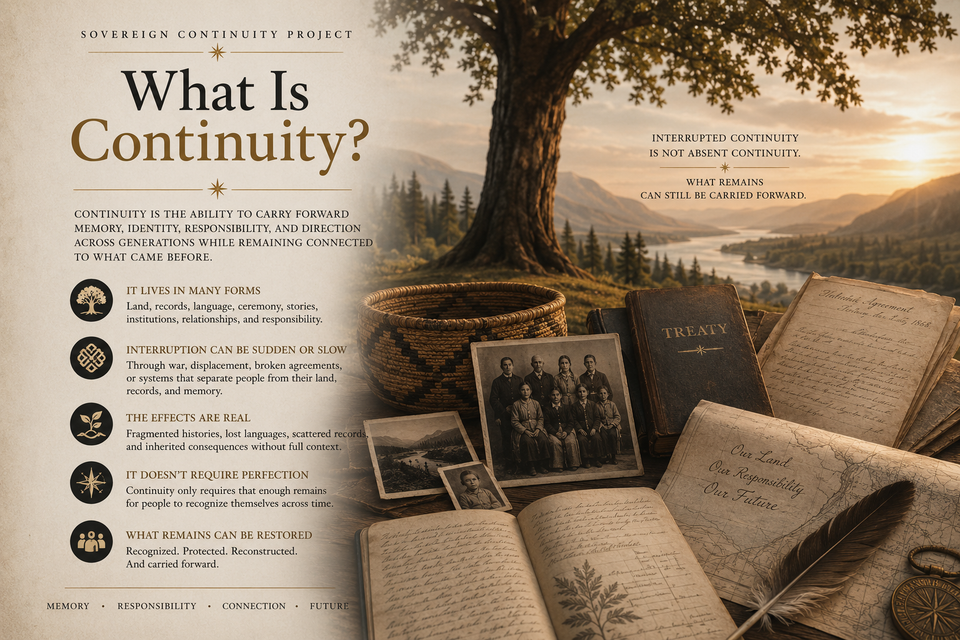
Continuity is the ability of a people, family, or community to carry forward memory, identity, responsibility, relationship, and direction across generations while remaining connected to what came before.
It is how histories remain living instead of disappearing.
It is how knowledge survives long enough to be inherited.
It is how people continue recognizing themselves across time.
Some forms of continuity are easy to see.
Land.
Records.
Treaties.
Governments.
Institutions.
Archives.
Maps.
Constitutions.
Community structures.
Other forms are quieter.
A story repeated at the table.
A name carried across generations.
A place remembered even after the land has changed hands.
A responsibility no one formally assigned, but everyone somehow understands.
A way of belonging that survives in memory before it is ever written down.
Many people inherit continuity without having to think about it.
They inherit names with records attached.
Land with paperwork attached.
Stories with institutions behind them.
Rights with systems prepared to recognize them.
But others inherit the consequences of continuity being interrupted.
They inherit fragments.
A family story without a document.
A document without context.
A remembered place without access.
A name that changed across records.
A people described by outsiders more often than by themselves.
Sometimes interruption happens suddenly.
Through war.
Removal.
Displacement.
Forced assimilation.
Conquest.
Broken agreements.
But often, interruption happens gradually.
Records are scattered across institutions.
Families are separated from land.
Languages fade within a generation.
Governance is altered.
Inheritance is fragmented.
Children are raised with pieces of a story, but not the full framework needed to understand what those pieces once belonged to.
Over time, descendants may inherit the effects of disruption without inheriting the language to explain it.
They may feel the absence before they can name it.
They feel it when family histories become difficult to trace.
When inherited stories cannot easily be verified.
When official records seem incomplete, displaced, or difficult to access.
When communities remember loss, but no longer possess the full institutional memory surrounding it.
When descendants inherit consequences without inheriting recognition.
Continuity matters because human beings do not arrive from nowhere.
We inherit conditions.
We inherit systems.
We inherit unfinished agreements.
We inherit relationships to land, memory, governance, language, and one another.
And whether we know it or not, we also inherit the responsibility of deciding what will be carried forward after us.
Continuity does not require perfection.
It does not require that every document survived.
It does not require that every institution remained intact.
It does not require that every generation fully understood what it had been given.
It only requires that enough remains for people to recognize themselves across time.
Sometimes that recognition survives in land.
Sometimes in records.
Sometimes in memory.
Sometimes in ceremony.
Sometimes in language.
Sometimes in descendants who continue searching even when the trail has been made difficult to follow.
Many people were taught to believe continuity had already been erased.
But interrupted continuity is not the same as absent continuity.
What remains can still be recognized.
Protected.
Reconstructed.
And carried forward.