How Sovereignty Becomes Interrupted
Most people imagine the loss of sovereignty as something immediate.
A war.
A conquest.
A government collapsing overnight.
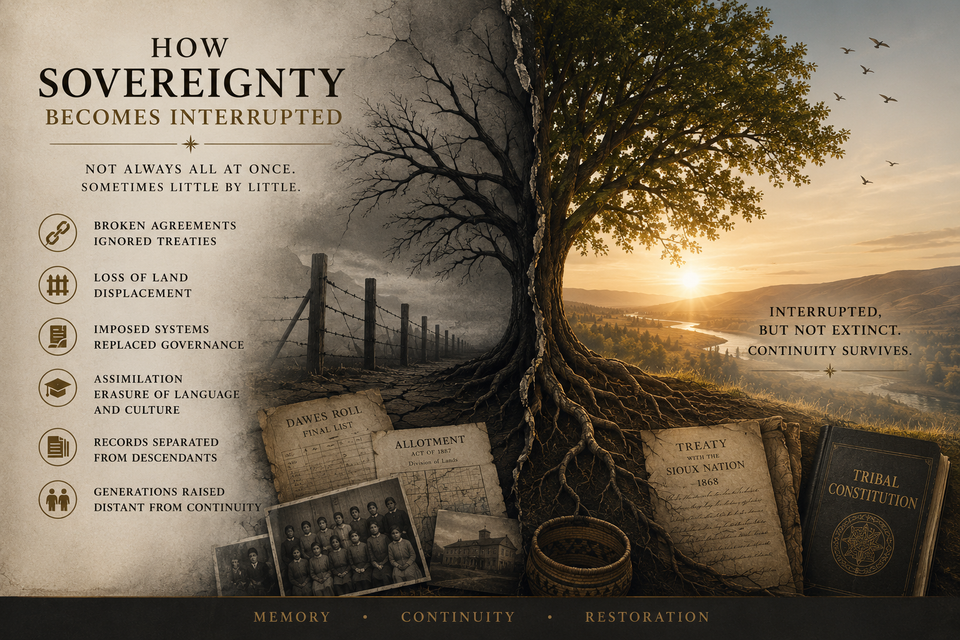
But many interruptions do not arrive all at once.
Sometimes they arrive quietly.
A community loses influence over its own land little by little.
A language disappears within a generation.
Children inherit stories, but not the records needed to fully understand them.
Outside systems slowly begin making decisions that once belonged to the people themselves.
And over time, what was once natural continuity can begin feeling distant, fragmented, or difficult to reach.
Often, sovereignty is not erased in a single moment.
Instead, the relationships that once carried continuity forward begin separating from one another.
Land becomes disconnected from memory.
Memory becomes disconnected from records.
Records become disconnected from descendants.
Governance becomes disconnected from the people most affected by it.
And after enough generations, many communities inherit the consequences of interruption without fully inheriting the frameworks needed to explain what happened.
Sometimes interruption happens through broken agreements.
Sometimes through displacement from land.
Sometimes through imposed systems that slowly replace older ways of governing, belonging, inheriting, or remembering.
And sometimes interruption happens simply because survival leaves very little room for preservation.
The result is not only political.
It moves through families.
Through education.
Through institutions.
Through economies.
Through the stories people are taught about themselves.
Over time, people can begin adapting themselves around interruption instead of continuity.
But interruption is not always extinction.
That matters.
Because many forms of continuity survive far longer than people realize.
Sometimes continuity survives in land relationships.
Sometimes in memory.
Sometimes in ceremony.
Sometimes in family structures.
Sometimes in records sitting quietly inside archives few people know how to navigate.
Sometimes in descendants themselves.
And sometimes what appears lost is actually unresolved.
This project exists because many histories were never fully concluded.
They were interrupted.
And understanding how interruption occurred is often necessary before continuity can be recognized clearly enough to be protected, restored, or carried forward again.