What Is Sovereignty?
Most people hear the word sovereignty and imagine governments, borders, treaties, or political authority.
But sovereignty begins much closer to home.
It begins with continuity.
Not only personal continuity, but inherited continuity — familial, communal, territorial, cultural, spiritual, and lawful relationships carried across generations.
At its most human level, sovereignty is the ability of a people to remain connected to their own systems of meaning, governance, inheritance, memory, and collective future while retaining the ability to carry those relationships forward across time.
And often, people understand sovereignty most clearly through its absence.
You can feel the absence of sovereignty when your history is told entirely by outsiders. When your community loses influence over land, governance, education, or inheritance. When survival begins replacing self-determination. When records defining your identity exist somewhere you cannot access. When decisions shaping your future are made far away from the people most affected by them.
Sometimes the absence is dramatic.
Other times it is quieter.
A language disappears within a generation.
A treaty relationship is broken.
A family loses connection to land it once depended on.
A community inherits fragments of its own story, but not enough to fully understand how those fragments once fit together.
Over time, entire peoples can begin adapting themselves around interruption rather than continuity.
And that interruption is never only political.
It moves through memory.
Through institutions.
Through economies.
Through family structures.
Through education.
Through land relationships.
Through the stories people are allowed to inherit about themselves.
Sovereignty, then, is not simply power.
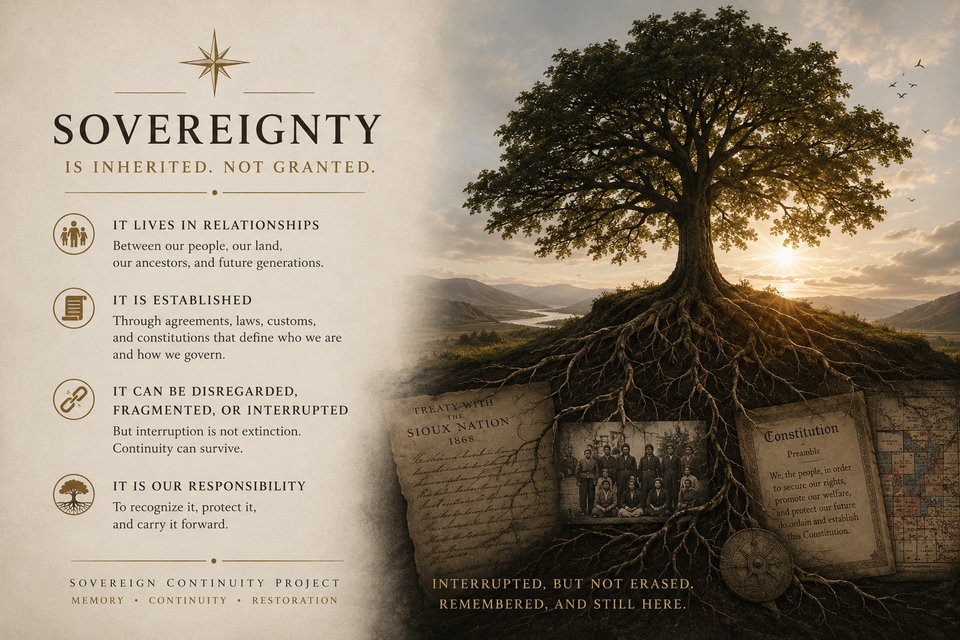
It is the ability to preserve and carry forward inherited continuity — including the agreements, governing relationships, collective responsibilities, territorial connections, and shared intentions established by prior generations, especially when those foundations were formally recognized, documented, and later disregarded, fragmented, displaced, or otherwise interrupted.
This project begins from the belief that continuity does not necessarily disappear when it is interrupted.
Sometimes it survives in records.
Sometimes in memory.
Sometimes in land relationships.
Sometimes in descendants themselves.
And sometimes the work begins simply by learning how to recognize it again.